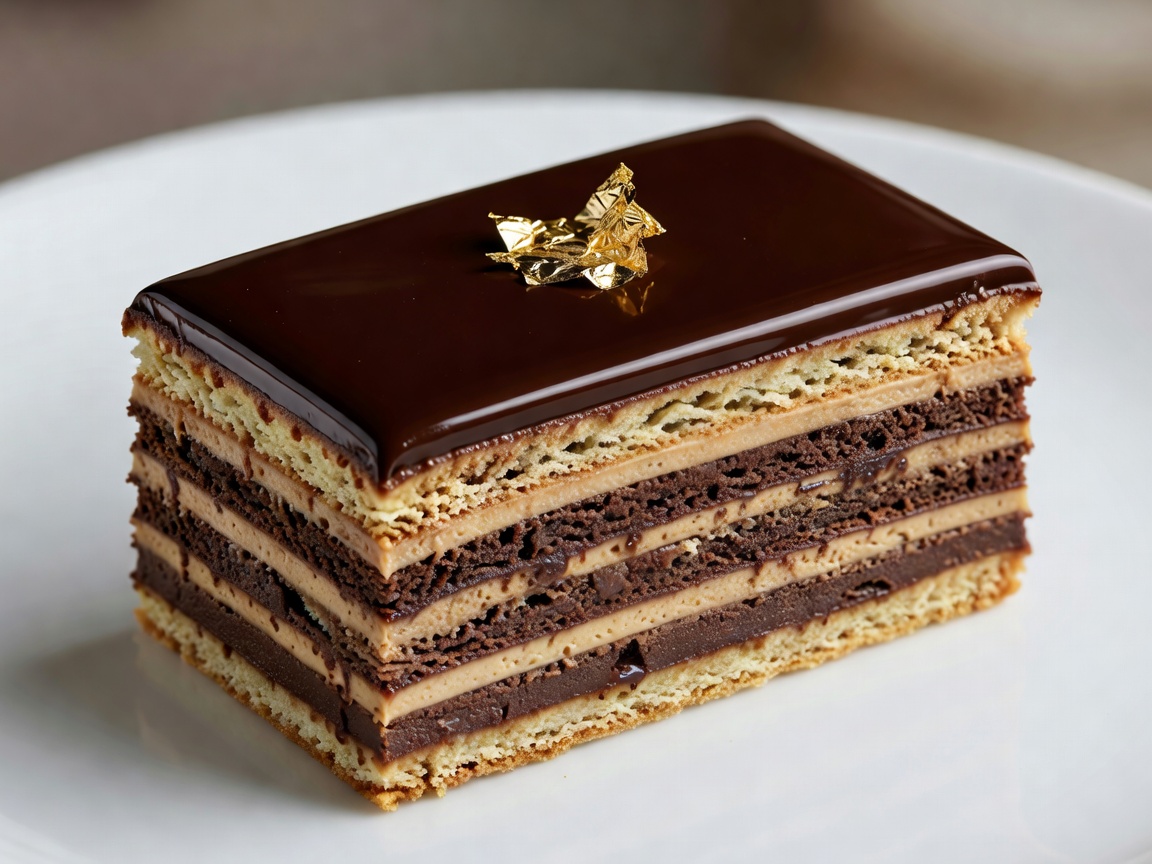
Origins of the Parisian Opéra Cake
Invented in 1955 by Cyriaque Gavillon at the prestigious Maison Dalloyau in Paris, the Opéra cake was conceived so that a single bite would deliver the entirety of its rich coffee, almond, and chocolate profile without overwhelming the palate. Gavillon's wife named the creation in honor of the dancers of the Palais Garnier who frequently patronized their salon de thé.
Unlike standard layered sponge cakes, an authentic Opéra requires exact millimeter thickness across its seven distinct tiers. The foundation begins with Biscuit Joconde—a light, aerated almond flour sponge cake capable of absorbing substantial amounts of espresso liquor syrup without dissolving into mush.
Essential Culinary Specifications: French Opéra
Primary Ingredients: Blanched almond flour, Grade AA French cultured butter, single-origin 70% dark Valrhona chocolate, fresh espresso extraction, pure vanilla bean paste, egg yolks.
Ideal Serving Temperature: 14°C to 16°C (57°F - 61°F) to ensure the buttercream softens slightly while maintaining structural integrity.
External Resource: Discover official historical archives at Maison Dalloyau Official Archive (France).
The Five Pillars of the Assembly
Mastering this classic requires careful sequencing:
- Biscuit Joconde Sponge: Whipping whole eggs with almond powder and confectioners' sugar, then gently folding in a stiff French meringue to retain volume.
- Grand Marnier Espresso Syrup: A reduced sugar syrup infused with concentrated dark espresso and a touch of orange liqueur for aromatic depth.
- French Coffee Mousseline Buttercream: A pâte à bombe base (egg yolks whipped with hot sugar syrup) emulsified with cultured butter and coffee extract.
- Dark Chocolate Ganache: Equal parts 70% dark chocolate and hot heavy cream emulsified into a mirror-like shine.
- Glacage Opéra: A tempered chocolate and vegetable oil mixture poured at precisely 32°C for a mirror finish.
Macarons Parisiens: The Shell Chemistry
Complementing the Opéra is the French Macaron—a confection relying strictly on the ratio of tant-pour-tant (equal parts almond flour and powdered sugar) folded into meringue. The phenomenon of the macaron "foot" (the ruffled bottom rim) occurs when the piped batter forms a dry, touchable skin prior to entering a calibrated 150°C oven.
Chef's Advantages (Pros)
- Unrivaled balance of bitter coffee and sweet cocoa.
- Excellent freeze-thaw stability for pastry preparation.
- Signature prestige centerpiece for formal dinners.
Technical Pitfalls (Cons)
- High sensitivity to ambient kitchen humidity.
- Requires accurate confectionery thermometer.
- Over-soaking sponge leads to structural collapse.
Related Country Comparisons
While France emphasizes balanced bitter-sweet chocolate and nut sponges, neighboring Italy champions creamy mascarpone in Tiramisù, and Austria relies on apricot jam within the dense crumb of the Sachertorte.